Closing the Rare-Species Detection Gap in UAE Camera Traps with Diffusion-Generated Data
ICICT 2026, published by Springer, pp. 342–351
In biodiversity monitoring, the species that matter most to conservation are often the ones a dataset barely contains. We test whether diffusion-generated images can close that gap for five under-represented species in a UAE camera-trap dataset, without more fieldwork.
The question
Camera traps are the backbone of biodiversity monitoring, but the resulting datasets are almost always long-tailed: a handful of common species dominate the frames, and the species conservation decisions actually hinge on are sparsely sampled. In the UAE's desert and mangrove systems, that imbalance is sharpened further by day/night variation, small or partially occluded targets, and frequent empty frames.
We asked whether class-conditional diffusion-generated images can raise rare-class detection F1-score over a real-only baseline, without additional field collection, and tried to characterise when synthesis helps and when it does not, rather than assume a single answer holds for every species.
Method
The dataset comes from Emirates Nature–WWF: roughly 66,851 camera-trap images across the Hajar Mountains, 15 classes, day and IR-night captures. We used the 8,355-image labelled subset from prior work on this dataset, with its existing 60–20–20 split. Five classes are severely under-represented: Camel, Cat, Ammomanes deserti (AD), Emberiza striolata (ES), and Oenanthe albonigra (OA), often with fewer than 200 real samples each.
DreamBooth Stable Diffusion v1-5 was fine-tuned separately on each tail class (manually screened for clear, full-body instances, 2,000 steps, learning rate 1×10⁻⁶), generating roughly 700 synthetic images per class. Real and synthetic data were then combined under two sampling policies, uniform (equalising totals across tail classes) and non-uniform (supplementing each class in proportion to its original size), at three mixing ratios (1:1, 1:2, 1:4), to fine-tune a YOLOv6 Lite-S detector for 40 epochs on an Nvidia A100. Fréchet Inception Distance (FID) was used throughout to quantify how close the generated images actually are to real ones.
Findings
Large, visually distinct animals gained the most.
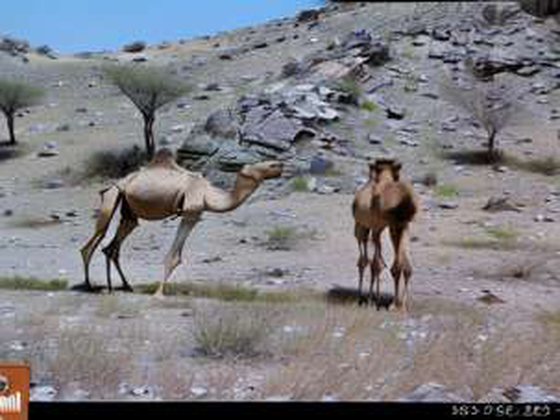
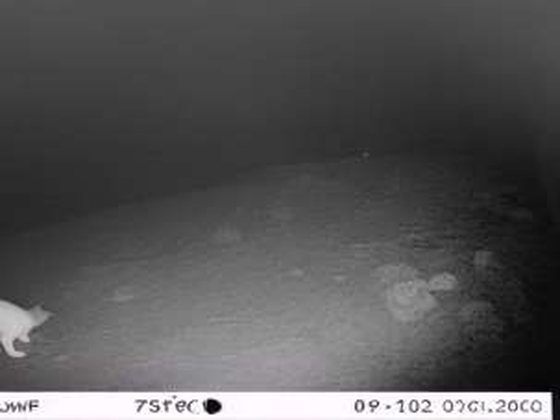
Cat went from an F1-score of 0.00 (the baseline detector missed every instance) to 0.36 at a 1:4 uniform ratio. Camel climbed from 0.79 to 0.86 at a 1:4 non-uniform ratio, with mAP@0.5 above 0.85.
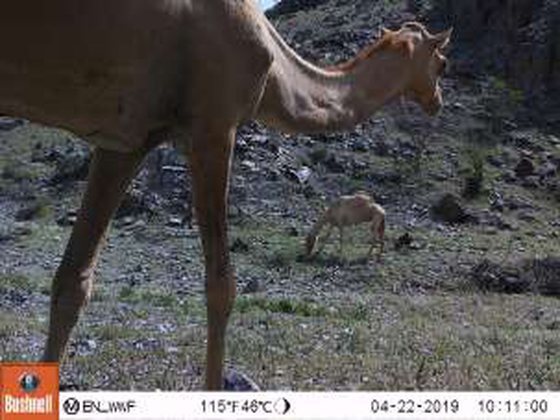
Real
Generated
Camel
F1 0.79 → 0.86 · lowest FID (634), most realistic of the five
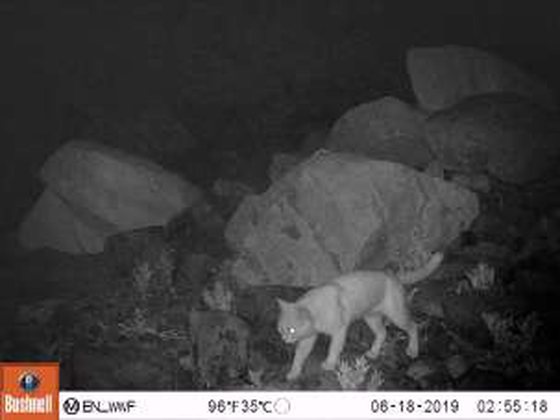
Real
Generated
Cat
F1 0.00 → 0.36 · highest FID (1362) of the five, yet the largest gain
Real
Generated
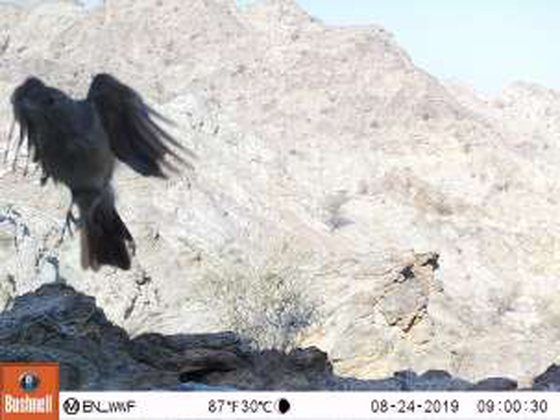
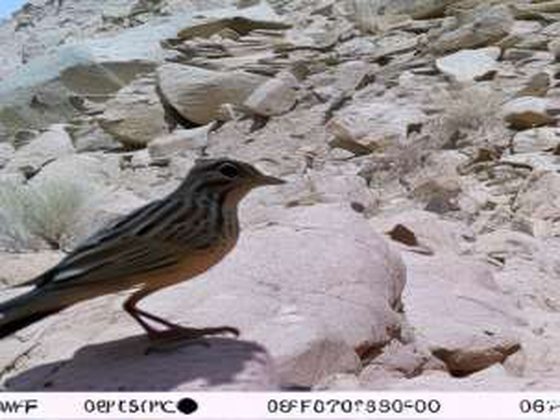
Ammomanes deserti
F1 stayed ≤0.10 throughout · generated frames read as close-ups, real ones are small and distant
The smallest bird species did not benefit.
Ammomanes deserti consistently deteriorated across every configuration, dropping to F1-scores as low as 0.04. At only a few pixels across in the real frames, even minor shape or texture drift in the generated images was enough to pull synthetic samples off the true distribution. Emberiza striolata showed moderate gains only at the highest ratio; Oenanthe albonigra was mixed.
Realism (FID) did not predict which classes benefited.
Camel had the best FID (634, most realistic) and a strong gain. Cat had the worst FID (1362) of the five classes yet the single largest F1 gain. Gains tracked object scale, visibility, and background congruence more than synthetic-real similarity or raw synthetic volume.
| Class | Base (real) | Unif. 1:1 | Unif. 1:2 | Unif. 1:4 | Non-unif. 1:1 | Non-unif. 1:2 | Non-unif. 1:4 |
|---|---|---|---|---|---|---|---|
| AD | 0.104 | 0.087 | 0.044 | 0.068 | 0.083 | 0.040 | 0.082 |
| Camel | 0.786 | 0.744 | 0.809 | 0.669 | 0.683 | 0.770 | 0.860 |
| Cat | 0.000 | 0.203 | 0.269 | 0.361 | 0.188 | 0.211 | 0.288 |
| ES | 0.345 | 0.349 | 0.332 | 0.467 | 0.340 | 0.311 | 0.423 |
| OA | 0.241 | 0.313 | 0.278 | 0.230 | 0.265 | 0.345 | 0.242 |
| All classes | 0.487 | 0.494 | 0.498 | 0.509 | 0.487 | 0.499 | 0.516 |
Why it matters
The species most critical to conservation outcomes are usually the ones with the least training data, and manual annotation at scale is slow and costly. Diffusion-assisted rebalancing shows it can reduce that annotation burden and meaningfully improve detection for some species, Camel and Cat here, without any additional field collection. But it is not a uniform fix: for small-bodied species photographed at a distance, synthesis can actively hurt detection. A camera-trap pipeline that adopts this approach needs to treat it as a class-by-class decision, not a blanket augmentation step.
Limitations
FID scores across all five classes (634–1362) are high by generative-modelling standards, indicating a real realism and domain-match gap between generated and real camera-trap imagery. The tail classes themselves have very few real exemplars to fine-tune on (as few as 18 Camel instances in the baseline), so results are exploratory rather than definitive, and the five-species, single-detector setup has not yet been tested against other architectures or other camera-trap sites.
A class-aware synthesis protocol, such as stricter exemplar filtering, habitat- and pose-aware prompt design, and tools like ControlNet for spatial guidance, is the natural next step to narrow the realism gap and stabilise benefits for small-bodied targets.
Citation
@InProceedings{10.1007/978-3-032-35982-7_30,
      author={Sallouh, Abdu and Faridi, Aariz and Alzagim, Khumam and Dabbagh, Mohamad and Sajun, Ali Reza and Zualkernan, Imran and Habib, Altaf and Gardner, Andrew},
      editor={Yang, Xin-She and Sherratt, R. Simon and Dey, Nilanjan and Joshi, Amit},
      title={Closing the Rare-Species Detection Gap in {UAE} Camera Traps with Diffusion-Generated Data},
      booktitle={Proceedings of 11th International Congress on Information and Communication Technology},
      year={2027},
      publisher={Springer Nature Switzerland},
      address={Cham},
      pages={342--351},
      isbn={978-3-032-35982-7},
      doi={10.1007/978-3-032-35982-7_30},
}